I feel very cosmopolitan flying to see my aunt in Amsterdam, hopping on the phone with cousins in Moscow, and writing postcards for extended family in Nantes. But the part of the story that’s less suitable for glossy pages of travel magazines is how folks ended up so scattered all over the world and what they had to leave behind.
At the ripe old age of 4, my interests included bunny rabbits, chocolates (particularly from the russian candy factory called “Red October” – I was a proper Soviet child), listening to my second cousin Levon play the accordion, and watching the children’s evening program on TV (here’s the YouTube link to the opening and closing themes for all my Soviet folks – try not to cry).
On this particular evening in the winter of 1988 we were visiting Levon’s family, and with him being older, he was put in charge of watching me. This made it easy for me to nag him into playing his accordion for me again and again. After dinner the adults had stayed behind in the kitchen, which meant that the living room TV and candy dish were now my domain (try and stop me, Levon). The sugary sweets would surely keep me up past my bedtime – but the adults seemed to be none the wiser.
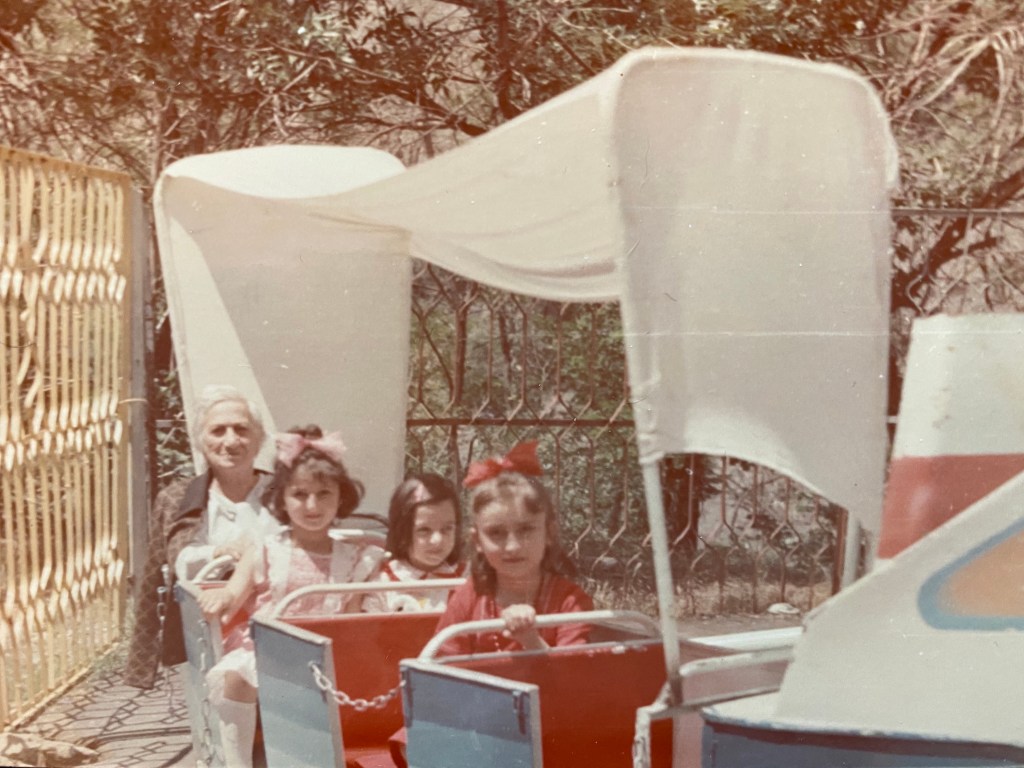
In the kitchen they huddled around the radio. Every now and then I’d hear one of them exclaim in incredulity and what sounded like maybe anger or fear. But cartoons were on – what did I care about a bunch of adults and their boring radio? When suddenly the phone rang: long rings of a long distance phone calls – back then you could always tell.
So much for being afforded the peace of my evening cartoons – all of a sudden I had 5, 6, 7 adults stampeding into the living room to the telephone. Levon’s mom, my first cousin once removed, Veta was shaking and out of breath when she answered the phone. “It’s from Sumgait,” she said, “it’s grandma Emma. They are ok.” I could hear the adults in the room exhale in unison. But the phone line must have cut out, because all of a sudden Veta was blowing into the phone and jiggling the switch button.
My parents’ generation was the first one to be born in (Soviet) Armenia. My dad’s people were from Van in Western Armenia (now Eastern Turkey), and my mom’s people were from Baku in Azerbaijan. This meant that my family spoke Armenian with accents that used to embarrass me when I was a teen. It also meant that both sides of the family had experienced genocide, pogroms, killings, and persecutions in the communities they had come from. There was generational trauma. There were stories of grandpa Tachat being smuggled from Turkey across a desert by his older sister when he was a baby. There were stories of people disappearing out of their homes in the middle of the night, never to be heard from again (back in the Soviet days European education earned you a one way ticket to Siberia). But in 1988 I hadn’t heard these stories yet – that would come later.
In 1988, the Soviet Union stood on the brink of collapse, and the republics that had been forced into configurations that disregarded ethnic populations and historical borders for the previous 70 years broke out into skirmishes of ethnic violence and, later, all out wars. In 1988 the adults in my family stood by the phone and waited with baited breath, hoping grandma Emma would call back. There was a lot of waiting around back in those days. Waiting to see whether the country would fall apart. Waiting to see whether men my dad’s age would be drafted into the army as the newly free Armenia went to war. Waiting for months to see if salaries would get paid. Waiting in lines for bread, sugar, kerosene. (The answers to all the waiting were “yes,” “no,” “no,” and “damn those endless bread lines.”)
That night the radio program in the kitchen had told of rapes and murders of the Armenian population in Sumgait: homes and businesses set aflame, folks forced to flee the communities they had made home for generations. But thankfully my grandma Emma, my mom’s aunt, made it out and to Yerevan. She was old and tiny, fragile almost. Her hair was snow white and her hands shook. It was early spring when she arrived in Yerevan, and I remember her wrapped in a thick crocheted shawl that smelled like moth balls. I took to her immediately, not the least of it because she was an expert at braiding hair despite the arthritis in her hands. She’d had lots with her own grandchildren, my second cousins. Back in the spring of 1988 she sat by the phone in cousin Veta’s living room, with me at her feet, waiting on the phone to ring with news from her son who had stayed behind, while brushing my hair. There was a lot of waiting back in those days.
P.S. Grandma Emma’s family: her son, daughter-in-law, and grandchildren, did end up making it to Yerevan a short time later. They had stayed behind to lock up their house in Sumgait even though they knew they were never going back and would never see it again. They spent the spring and summer living at cousin Veta’s, all 5 of them sleeping in Veta’s living room: Emma and the grandkids on the pull-out couch, uncle Goga and his wife on the floor. I loved having the girls, Emma’s granddaughters Sveta and Lena, around. They were older than me, already in middle school, but let me carry on with them and even painted my nails that summer. But when fall rolled around, they moved to Russia – the political situation in Armenia had already started to feel precarious, and I suppose there are only so many tragedies a family can sit around waiting for.
 Packing List for Immigration
One thought on “Pack… Your Patience”