The thing that happens when you grow up without electricity is that you become really adept at entertaining yourself. Of course, at 10 years old I would have preferred to park myself in front of the television, except in this scenario the television was disappointingly blank. So I read voraciously. First children’s books, then young adult books, then art history books and opera librettos (my mom always loved all kinds of art and had held a number of art-adjacent jobs, so now I’m the person who smugly does not need subtitles at the opera).
But sometimes books didn’t quite cut it. That’s when all the neighbourhood kids went outside to play. I grew up in a two-bedroom apartment in a 14-story Soviet-style building. Ours was one of four identical buildings, across the street from a cluster of 9-story buildings, which, in turn, had a few other buildings behind them. What this resulted in was a ton of other kids to play with. You just had to find your group.
The groups of kids were divided by age, language, and primary activity. The 14-15 year old Russian-speaking girls typically just strolled up and down the street, talking about boys, flirting with boys, making eyes at boys. The 12-13 year old Armenian-speaking girls played games I’d never even heard of (it was amazing how language could define culture, even when you were growing up on the same block). The 10-11 year old Armenian-speaking boys squatted around, ate sunflower seeds, and picked on the girls. And occasionally all these groups would converge to play one big game of gortsnagorts (գործնագործ – similar to dodgeball but different, which results in my thinking that I should be not terrible at dodgeball, but I am).
I was about 10 at the time and spoke primarily Russian (my elementary school was Russian, but after the Soviet Union broke up, all education switched over to Armenian – good strategic move when you are trying to survive as nation of 3 million people, but I had the hardest time learning what I now consider to be my first language; and no, the two aren’t similar at all). And here I was, trying to figure out where it was that I fit in and who my people were.
Turned out that my people were 9-10 year old girls who spoke primarily Russian like me (although we all peppered in Armenian words into our speech), jumped rope like maniacs, played a mean game of badminton, and crushed at dodgeball (I know we’ve already established it wasn’t dodgeball, but for the sake of the translation we’re going to stick with it). We were a core group of 5, with a few visiting cast members, like our friend Liana’s sister Izolda, who was only 6 at the time, too young for our squad, but we’d bring her along if we needed someone to fit between the slats of a fence if we were stealing unripe apricots from a neighbor’s garden.
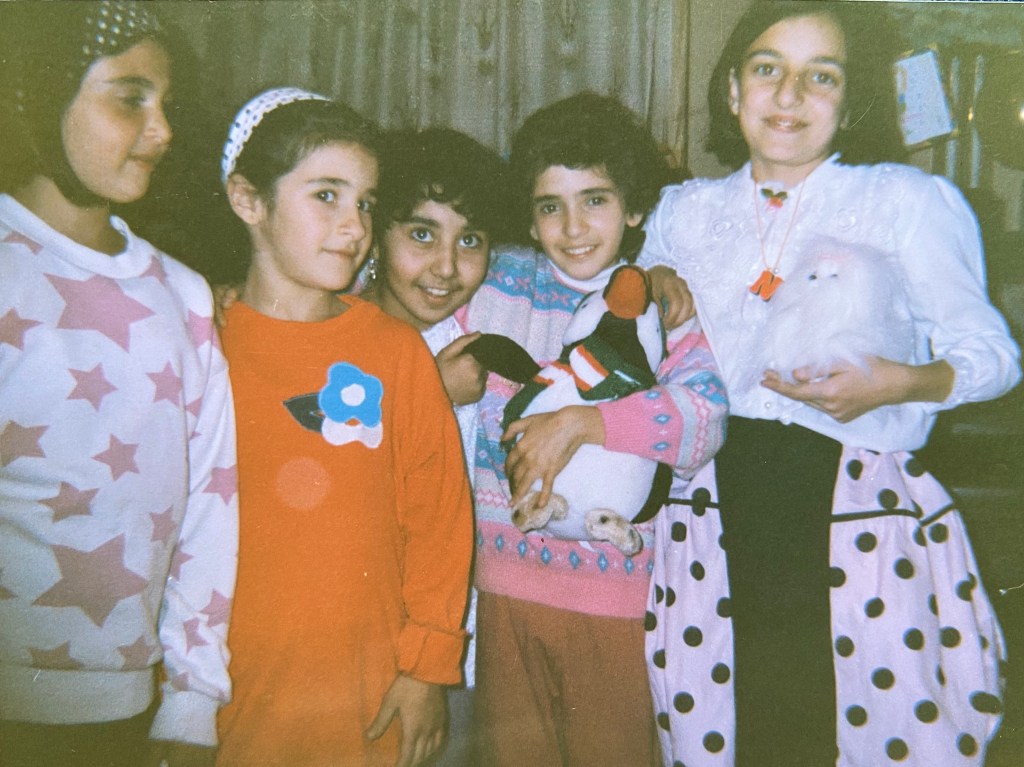
We did everything together and knew everything about each other. We wore each other’s hand-me-downs and shared our lunches when we knew someone’s family was hard up that month. Regina’s grandma would often help us with our Russian homework, and her dad kept bees so he’d bring us honey. Karine’s dad was the person to go to with math homework, and her mom, a kindergarten teacher, would help us make all our costumes for the performances we would put on for the folks on our block. Liana’s family had a bus battery (which they would charge during the one hour when we had electricity each day and then would use to power the TV), a VCR, and a Nintendo, so theirs was the home we most often ended up in. Some of my best childhood memories are of our girl gang hanging out at Liana’s house, watching Little Mermaid dubbed into Russian, singing along with Sebastian, while her poor mom was probably trying to figure out how she would feed a group of hungry kids that she did not have enough food for.
We each had our roles in our little squad. I was the oldest, the one in charge of throwing rocks at boys if they ever picked on anyone in the group, in charge of expeditions into the abandoned house down the block, in charge of rescue operations aimed at every single stray dog in the neighbourhood (I’d often bring them home, but it was very challenging to hide a puppy in a small apartment as they would all inadvertently bark at some point). Liana (the one whose sister Izolda would fit between the slats of the fence) was in charge of letting us play her Nintendo. She was the first and the only one in our group to get a game console and was incredibly generous with it.
Except for that one time. We had another friend, Gohar, who lived in the same building as Liana. On this particular day we were all invited to come play Super Mario Brothers except for Gohar, who, regardless of not being invited, showed up in short order anyway. Liana absolutely wasn’t going to have any of it. In an attempt to avoid having to invite Gohar over, Liana had all of us hide under and behind furniture. She answered the door, saying that she couldn’t play – her mom was making her do housework that day (not a super unusual thing for an Armenian 8 year old to be doing). Gohar said that she’d seen all of us come over. Liana flatly denied it. Gohar said she could hear a commotion. Liana responded that it must have been “the snake.” Gohar sighed in exasperation (wouldn’t you at some crazy snake story?), gave up her attempts to try and be invited, turned on her heel and left (in hindsight, we should have probably been more inclusive but kids can be mean and clique-y and this was the day that Liana wasn’t into inviting Gohar over).
The thing is, Liana’s dad kept a number of snakes, lizards, and other reptiles as pets. And they did in fact have a large python that had outgrown its terrarium and was now just roaming around the living room. We made a rather close acquaintance with it while trying to hide from Gohar behind the furniture (hello!). And since there were two different Lianas in the neighborhood, our Liana had now officially become “the Liana of the snakes.”


Wow, you definitely had an interesting childhood. Good post.
LikeLiked by 1 person